
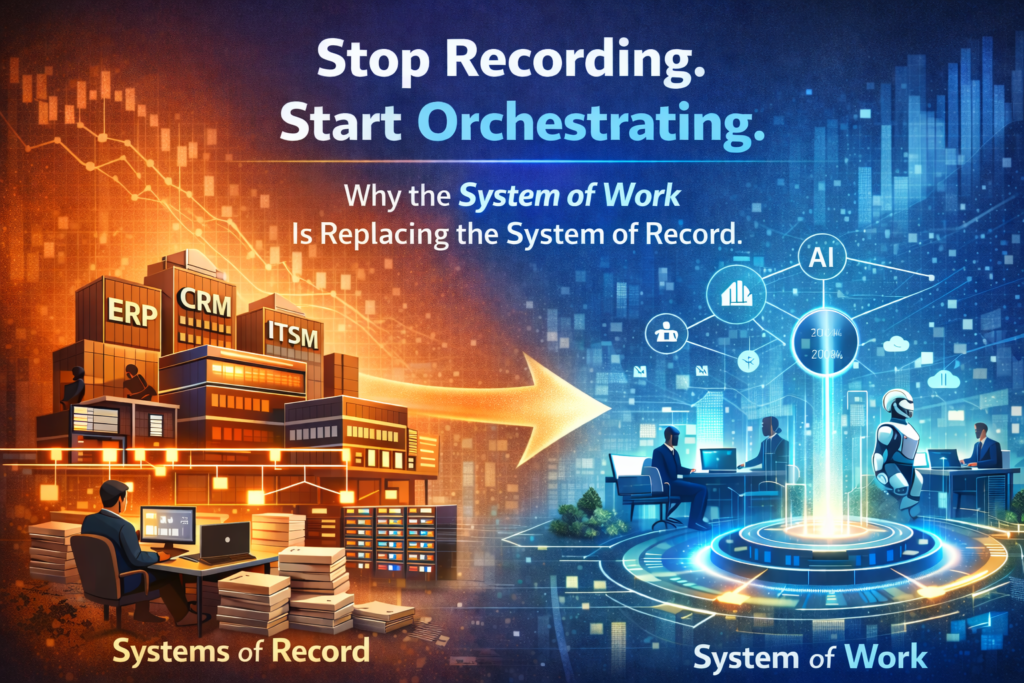
While these systems initially provided a necessary foundation for the digital age, they were built for a human-centric era, more for transactions and data logging rather than operational execution.
Recent market volatility has seen the cooling of legacy SaaS platforms illustrated by their tanking share valuations. This represents a fundamental re-evaluation of the software vendor business model.
The message is undeniable: The era where the ledger dictates the workflow is over.
Today, enterprise is moving beyond the record. We are witnessing a paradigm shift toward the System of Work.
The “SaaS Tax” and the Rigidity of the Monolith
The traditional SaaS model was a masterclass in vendor capture. Organisations were sold ‘best practices’ that were merely ‘transactional practices’, which are generic but appropriate processes. They were void of management practices containing unique management intellectual property (IP), an organisations competitive or policy advantage.
This business model has hit a terminal breaking point due to three structural failures:
-
- The Customisation Trap: Legacy SaaS models create vendor lock-in by hard-coding your unique management processes into their proprietary platforms. This creates a ‘trap by design’ where the cost and complexity of migrating your intellectual property into a proprietary System of Record become prohibitively high. Once locked-in, enterprise is forced to accept price hikes and stagnant technology because separating your operations from the vendor’s software is cost prohibitive.
-
- The Integration Trap: This occurs when rigid platforms are connected via custom, hard-coded links that are expensive to build and easy to break. As these connections multiply, your architecture becomes so brittle that a single software update can trigger a system-wide failure. This forces the enterprise to spend your budget on ‘staying still’ through constant maintenance rather than investing in new business capabilities.
-
- The Continuous Improvement Trap: To customise, companies hire armies of consultants to design and maintain brittle, hard-coded integrations and process customisations. When the commercial and or policy environment changes, continuous improvement is reliant upon third party system integrators to manage that change at great expense
What then results is a reliance upon expensive vendors who are locked-in after multi-year implementation programs. They obtain change-request pricing leverage and long-term dependence on Tier-1 system integrators.
The Catalyst: Associations, Agentic AI and Natural Language Logic
Three forces have accelerated the obsolescence of the System of Record: Agentic AI, the rise of Generative Development and the practice of Association instead of Integration
We have moved beyond chatbots that wait for prompts to deploy a ‘Silicon Workforce’, consisting of autonomous agents capable of executing end-to-end workflows. If an AI agent can perform the work of five analysts, the enterprise no longer requires five software licenses. The ‘seat-based’ moat is being drained, and legacy vendors are struggling to justify their pricing as their human-centric model evaporates.
Traditional integration relies on brittle, hard-coded connections that break whenever a system is updated, creating a permanent cycle of technical debt. Association replaces this with a logical ‘map’ that recognises relationships between data points without permanently stitching the underlying platforms together. By linking the context instead of the code, you gain a resilient, modular architecture where software tools become plug-and-play components that can be swapped out without disrupting your core business operations.
The Solution: The System of Work, DOLIUM
If the System of Record is the library, DOLIUM is the air traffic control tower. It is a new Control Plane for the enterprise that embeds strategy, accountability and AI directly into the flow of management level execution.
Rather than attempting to replace the necessary financial and data foundations of the enterprise, DOLIUM acts as an Operations Repository. It holistically models your operations by creating a unified layer that codifies your unique management logic, strategic objectives and workflow interdependencies into a single, cohesive control plane. This separates the Management Layer (the logic, policy and “how” of the business) from the Transactional Layer (the data storage), ensuring your intellectual property remains under your control.
A governing System of Work removes this burden by externalising management process logic and governance, allowing ERP to remain largely a COTS product to be configured, not customised. This materially reduces implementation effort, future change costs and vendor lock-in.
Importantly, while ERP licence fees may appear static in the short term, DOLIUM significantly reduces vendor pricing leverage. By minimising reliance on ERP change cycles and paid enhancements to implement policy or process change, commercial power shifts back to the enterprise. This is where long-term savings are realised, particularly across sustainment and future tranches.
Third, as agentic AI is embedded within a governing System of Work, ERP platforms increasingly become structured data repositories rather than centres of operational logic. Over time, this reduces training burden, simplifies operating modelsand places downward pressure on ERP licence costs as functional differentiation shifts away from the ERP layer.
The Orchestration Layer: One Control Plane, Every System
While traditional IT architecture resembles a collection of disconnected islands, HR in one, Finance in another, Supply Chain in a third, DOLIUM acts as the Connective Tissue. It functions as the universal management and orchestration layer that sits above your existing ecosystem, providing a single pane of glass for operational execution.
Rather than forcing users to navigate between disconnected platforms, DOLIUM orchestrates the flow of work across them. It treats your legacy Systems of Record as pluggable services rather than fixed destinations.
-
- Unified Governance: Instead of managing policy and compliance within five different systems, you define it once in DOLIUM. The platform then orchestrates those requirements across your ERP, CRM and ITSM.
-
- Cross-Functional Orchestration: DOLIUM breaks down silos by managing workflows that span multiple departments. It can trigger a procurement action in your ERP based on a project milestone in your PLM, all while maintaining the strategic “Why” behind the movement.
-
- System Agnosticism: Because DOLIUM manages the logic of the work, the underlying transactional software becomes interchangeable. If you decide to migrate from one CRM to another, your management IP and operational workflows remain intact in DOLIUM, drastically reducing the risk and cost of system migration.
By acting as the orchestration layer, DOLIUM ensures that your enterprise systems finally work for the business, rather than the business working to keep the systems synchronized.
AiDA: The Engine of Alignment
While other platforms “bolt on” AI as a sidecar, DOLIUM features AiDA, an agentic engine that understands the operational context of your business. AiDA is grounded in your organisation’s specific Mission, Outcomes, and Objectives. It becomes your Small Language Model to ensure that every action, whether performed by a human or a silicon agent, is goal-aligned, auditable and business-aware. By providing the “why” that legacy systems lack, AiDA closes the Semantic Gap, turning stagnant data into proactive execution.
Reclaiming Management IP
By decoupling your management logic from your transactional System of Record software, DOLIUM allows you to reclaim your proprietary processes. You are no longer forced to ‘kidnap’ your own institutional knowledge by locking it into a vendor’s rigid workflow.
This shift protects your competitive advantage, make your decision making processes transparent to those that count and allows you to use best-in-class applications without the friction of brittle, expensive integration projects.
The Economic Reality: Reclaiming Commercial Leverage
The economic impact of this transition is massive. Moving from a model where you rent your processes to one where you own your operational logic turns a constant drain on resources into a permanent competitive advantage.
By moving your operations into a System of Work, you achieve:
-
- Sovereign Data and Logic: You gain the freedom to swap out the “record” layer (the ERP or CRM) without breaking your “work” layer. You are no longer beholden to a vendor’s roadmap.
-
- Resilience over Rigidity: Because you link the context instead of the code, you gain a resilient, modular architecture. Tools become plug-and-play components that can be changed without disrupting core operations.
Lead the Shift
The transition from Systems of Record to the System of Work is an evolution of power. The centre of value creation has moved from the ledger to the logic.
By integrating a platform like DOLIUM, organisations ensure that technology finally plugs into the business, rather than the business being forced to plug into the technology. Stop maintaining yesterday’s limitations. The System of Work doesn’tjust record the past; it orchestrates the future.