
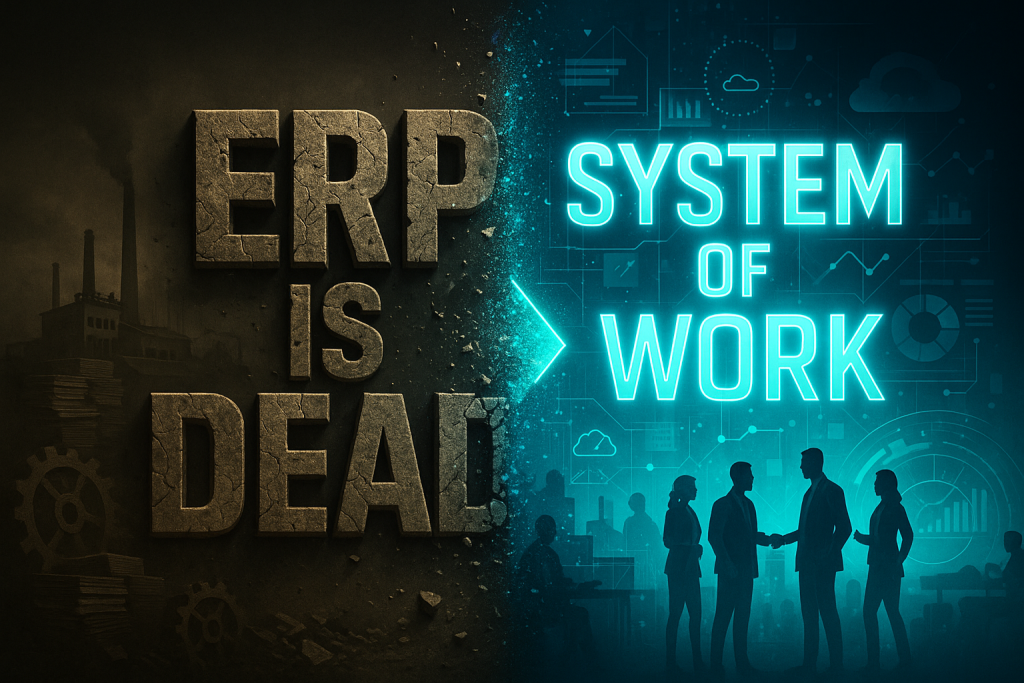
Big ERP systems are slowly becoming obsolete, much like Kodak, Nokia or Digital. Why?
Because they can’t keep up with the pace of change, the demands for business agility nor the opportunities created by AI.
The future isn’t another monolithic upgrade. It’s a completely new paradigm – its the System of Work.
From Systems of Record to the System of Work
For decades, ERP, CRM and ITSM platforms positioned themselves as the ‘Systems of Record’. Central repositories to capture transactions, enforce structure and provide a level of transactional compliance.
They grew to dominate the enterprise landscape, propped up by multinational system integrators who profited from the endless cycles of customisation, integration and upgrades.
But as Jan Baan, one of ERP’s original pioneers observed, this model is fundamentally flawed. ERPs lock customers into rigid architectures, impose ‘best practice’ that serve the vendor more than the client and struggle to adapt.
What once was innovative is now a drag on enterprise value.
The ‘System of Work’ changes the game.
Why ERP is Dying
- Vendor Lock-In Has Peaked.
- ERP/CRM vendors and their partners built empires through lock-in. But this model is cracking under its own weight. Organisations are rejecting the high costs and limited freedom.
- Customer Centricity is Gone.
- ERP/CRM used to solve business problems. Now it serves vendor shareholder value. The ability to shape technology around real work has been lost and the system integrators are their enablers
- Moreover, when a System Integrator or Big 4 accounting firms establishes a service line around ERP applications, you know they are serving their own, not your interests
- Monoliths Can’t Keep Pace.
- Business evolves faster than any ERP release cycle. By the time new modules arrive, the market has moved on or organisations engage multi-national system integrators to adapt.
- ‘Best Practices’ Are Vendor Practices.
- What vendors call best practice is usually just generic, one-size-fits-all process packaging. It rarely delivers competitive advantage.
- ERP/CRM Is Just a Database.
- At its core, ERP records transactions. It doesn’t understand business context, it doesn’t orchestrate work and it doesn’t empower decision-making.
- Orchestrated Ai is relegating ERP/CRM into undifferentiated structured datasets.
The System of Work: What Comes Next
Unlike ERP/CRM, the System of Work is more than a glorified database. It provides the business context, ensures alignment with strategy, and enables AI assisted operations in real time. It is your management IP that provides a competitive advantage:
- Business context at the core.
- The System of Work interprets data in the context of goals, outcomes and operational activity. It doesn’t just show what must happen, it helps to understand why you’re doing it, who’s depending on it, and what comes next.
- Adaptive by Design.
- No more rigid architectures. The System of Work is modular, composable and continuously evolving by the in-house staff that actually perform the work.
- AI-Native.
- Artificial intelligence isn’t bolted on, it’s the foundation. Predictions, recommendations and automation drive productivity and accelerate decision-making.
- AI acts as another role in the organisation accountable to others with the same responsibilities as its human counterparts
- Freedom from Lock-In.
- Built on open standards, APIs and interoperability, the System of Work avoids vendor captivity. It gives choice back to the customer.
What This Means for Leaders
- Face the Sunk Costs.
- Billions have been spent on ERP. But those are sunk costs. Doubling down on yesterdays technology is wasteful. The smarter move is to build forward with a System of Work.
- Stop Wasting Resources.
- Stop pouring time, money and talent into maintaining yesterday’s technology. Redirect resources toward innovation that creates real policy or commercial value.
- Lead the Shift.
- The transition isn’t about another upgrade cycle, it’s about changing how work is orchestrated, decisions are made and outcomes are delivered.
Where the Cost Savings Are Actually Realised
We acknowledge market observations that claims of material ICT savings can appear counterintuitive if ERP licence costs remain unchanged. However, this view does not fully account for additional cost drivers within contemporary organisations operating models.
- First, traditional ERP/CRM centric approaches impose a substantial integration and customisation burden that typically involve expensive point-to-point integrations, custom workflow development, vendor-locked configurations and ongoing dependency on multinational system integrators.
A System of Work requires none of these as it operates as a control plane, linking out to existing Systems of Record. This is all achieved without hard code integrations, avoiding multi-year implementation programs, change-request pricing leverage and the compounding cost of customisation over time. Importantly, by removing extensive customisation and integration, ERPs can be replaced or renegotiated more easily, reducing vendor lock-in and the price premium this inevitably attracts.
- Second, while ERP licence fees may remain static in the short term, a populated System of Work materially reduces the pricing leverage of ERP and CRM vendors. It does this by reducing reliance on ERP change cycles, minimising the frequency of paid enhancements and removing dependency on Tier-1 vendors to implement policy or process change. This rebalances commercial leverage back toward clients, where long-term savings are realised.
- Third, as agentic AI is leveraged alongside a System of Work, ERP and CRM platforms are increasingly becoming known as structured data repositories rather than centres of operational logic. Over time this shift will place downward pressure on ERP licence costs while also eliminating the structural inefficiencies and training burden associated with ERP-centric operating models.
Beyond ERP-related savings, DOLIUM delivers additional material ICT benefits.
The Bigger Picture
ERP may linger for compliance and record-keeping, but it is no longer the centre of enterprise gravity. Its role will diminish to background infrastructure.
The centre of value creation is shifting to the System of Work, a platform that integrates people, processes, data and AI into a living system that continuously drives performance.
This is not evolution. It is replacement.
The System of Work doesn’t just record the past. It shapes the future.