
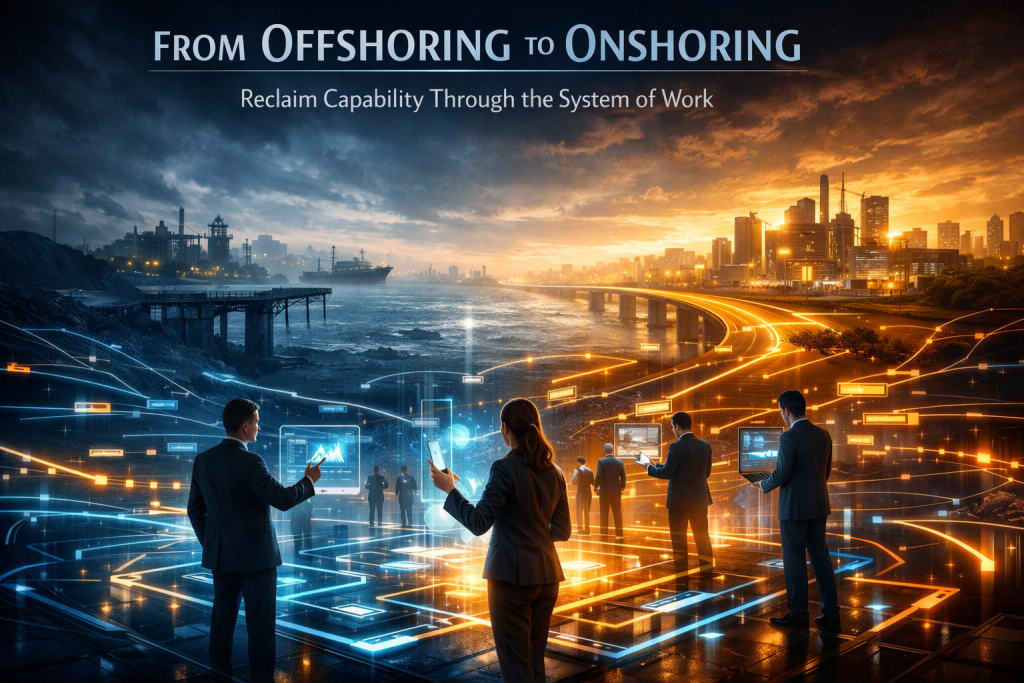
For decades, offshoring has been framed as a rational, even inevitable response to economic pressure. Rising labour costs, skills shortages and the relentless drive for efficiency pushed both public and private sector organisations to move work offshore. In many cases, the decision was defensible.
Today the conditions that made offshoring attractive are changing faster than most operating models.
The emergence of agentic AI, decision-centric Systems of Work and sovereign digital capability now presents a credible alternative: not simply reshoring work, but reclaiming sovereignty of purpose and delivery.
The Original Reasoning for Offshoring
Offshoring was never about geography. It was about control of cost, access to capacity and predictability of delivery.
The dominant drivers were:
- Cost Arbitrage. Labour-intensive activities such as processing, administration, compliance and reporting were moved offshore to reduce unit cost. This was especially compelling where work was repetitive and rules-based.
- Capacity and Scalability. Offshoring provided access to large, elastic workforces that could scale up or down faster than domestic labour markets allowed.
- Standardisation of Work. As work was documented, systematised and handed off, it became easier to relocate. In many organisations, offshoring followed ERP and workflow implementations that reduced tasks to transactions.
- Skills Availability. Certain technical or operational skills were more readily available offshore, particularly for 24/7 operations and large back-office functions.
The Offshore Model Is Now Under Strain
What has changed is not sentiment, it is complexity. Modern organisations now operate in environments where:
- Agentic AI is transacting at speed;
- Human and cultural interaction is competitive advantage
- Speed of judgment outweighs speed of processing;
- Context is as important as data; and
- Policy and compliance are dynamic, not static.
At the same time, governments and boards alike are reassessing sovereign risk:
- Who truly controls delivery?
- Where does organisational knowledge reside?
- How resilient is the operating model under disruption?
This is not a rejection of globalisation. It is a recognition that outsourcing cognition is fundamentally different from outsourcing labour.
Bring It Back with Capability
The answer is not simply to reshore work and absorb higher costs. The alternative is to change the way work is performed. This is where System of Work fundamentally alters the equation.
System of Work with Generative & Agentic AI: A Different Operating Logic
This is not automation in the traditional sense. It is a System of Work that embeds agentic AI into the fabric of organisational decision-making.
Its agentic AI capability:
- Understands organisational context;
- Reasons across policies, data, and workflows;
- Orchestrates tasks rather than merely executing them; and
- Supports human decision-makers rather than replacing them.
Instead of sending work offshore to be processed, organisations can:
- Retain purpose locally;
- Delegate transactional execution to AI agents; and
- Keep human in the loop accountability, knowledge and intent onshore.
This is not about doing the same work cheaper, it’s is about doing different work better.
Sovereignty of Purpose and Delivery
At its core, this shift is about sovereignty.
Not sovereignty as a political slogan, but as an operational principle:
- Sovereignty of purpose. Decisions, priorities and intent remain with the organisation and not dispersed across vendors, contracts or time zones.
- Sovereignty of delivery. The ability to execute, adapt and respond is embedded in the system of work itself, not dependent on external labour pools.
With a System of Work:
- Transactions are automated across Systems of Record (ERP/ITSM/CRM);
- Decisions and human interactions accelerate instead of queueing; and
- Delivery becomes resilient by design.
This is particularly critical for governments and regulated industries, where trust, accountability and continuity are non-negotiable.
From Offshoring to Onshoring Intelligence
The next phase of productivity is not about moving work around the globe. It is about re-architecting how work happens.
Agentic AI enables organisations to:
- Bring critical functions back without re-inflating cost bases;
- Reduce dependency on fragile delivery chains; and
- Align technology with national, organisational and strategic objectives.
A System of Work provides the scaffolding that allows human potential to scale without being exported.
Conclusion
Offshoring solved yesterday’s problem: how to process more work at lower cost.
Today’s challenge is different:
- How to make better decisions faster;
- How to retain control in a volatile world; and
- How to build systems that serve purpose, not just efficiency.
With a System of Work incorporating an agentic AI capability, organisations can move beyond offshoring as a default strategy and toward a future defined by sovereignty of purpose and delivery.
A System of Work is the scaffolding for human potential.