
Australia has reached a critical juncture in how it approaches complex public and private projects. Billions are poured into digital systems, transformation initiatives and technology upgrades each year. Yet too often, the results fall short: over budget, late or worse, abandoned altogether.
A 2023 Parliamentary Inquiry into Government Service Delivery highlighted recurring failures, from fragmented IT procurement to duplication across agencies. These issues are compounded as humanity faces an imminent & ongoing AI revolution with broad implications for work and productivity.
In this article we will:
- Analyse the current state-of-play and learnings gained,
- Discuss the risks and pitfalls of unstructured knowledge and a lack of core-business articulation/understanding,
- Describe how a System of Work is different from other ICT categories & how it addresses the issues raised and lastly,
- Provide decision makers with the information necessary to lead Australia’s productivity and AI future.
Entering the AI future without a plan or with shaky foundations will expose many to escalating costs, vendor dependency and fragmented data landscapes that erode trust and decision-making. Those who take the time to define a System of Work will own their architecture and ultimately, their destiny.
Cost: Sunk or Opportunity
The sunk-cost problem is particularly visible in the investment made to Enterprise Resource Planning (ERP) systems. Governments and corporations alike have invested heavily in ERP platforms, on the expectation they would provide an integrated backbone for operations.
Instead, most of these projects have ballooned in cost while delivering limited returns.
A review of ERP programs in Australia found instances where billions were spent before the organisations finally confronted their reality and concluded that it could not meet their needs.
Persuasive system integrators try to convince leaders to “double down” rather than cut losses, however, doing so risks anchoring future work to outdated models. The promises of seamless customisation and transformation quickly become lengthy troubleshooting efforts, distracting from core-business. The lesson is stark: Australia cannot afford to keep building the wrong way, patching failures or dragging sunk costs forward.
Success depends on doing it right the first time.
Vendor Incentives & Risk of Shortcuts
It is tempting to seek “easy wins.” ICT vendors offer best-of-breed Systems of Record. However, during the implementation, System Integrators will often come along and upsell by explaining that the ‘out-of-the-box solution’ requires tailoring and customisation to fit the organisation’s needs.
Traditionally, once the road of customisation has begun, the projects expand in both complexity & cost, often benefitting aligned interests and external consultants.
Woolworth’s attempt at implementing an ERP is a good example. In that case: 6 years and an eye-watering $200M+ AUD was spent on the failed project.
Let’s not even mention the current problems at the Australian Department of Defence.
For AI, vendors promote turnkey solutions, promising rapid ingestion and insight without the hassle of foundational knowledge management (KM) efforts. But these shortcuts create hidden and exponential costs: noisy data, misaligned outputs and long-term dependency.
If knowledge isn’t structured first, the AI space risks repeating the same cycle. For many, it will only become apparent in retrospect.
Knowledge as Australia’s Undervalued Asset
While capital has been wasted on failed systems-led transformations, true value has quietly been leaking elsewhere. Studies suggest as much as 80-85% of organisational knowledge is tacit. That is: stored in people’s heads, shaped by experience and rarely documented or systematised. When employees leave, retire or shift roles, that knowledge often disappears with them.
This loss is not abstract. A WA parliamentary inquiry into regional health services noted how the absence of structured processes for capturing and sharing know-how directly impacted service quality and workforce sustainability. Similarly, Macquarie University research has found tacit knowledge underpins all forms of organisational knowledge, yet it is often overlooked precisely because it resists easy codification.
In other words: the single greatest untapped asset in Australia’s economy is not technology or infrastructure, but knowledge itself. Yet it remains the least managed.
From Systems of Record to Systems of Work
Too often organisations conflate Systems of Record (transactional, rigid platforms like ERPs) with true organisational intelligence. Systems of Record are excellent at capturing historical transactions, enforcing compliance and storing structured data. But they rarely capture the nuances of how work actually happens or the tacit knowledge that drives value.
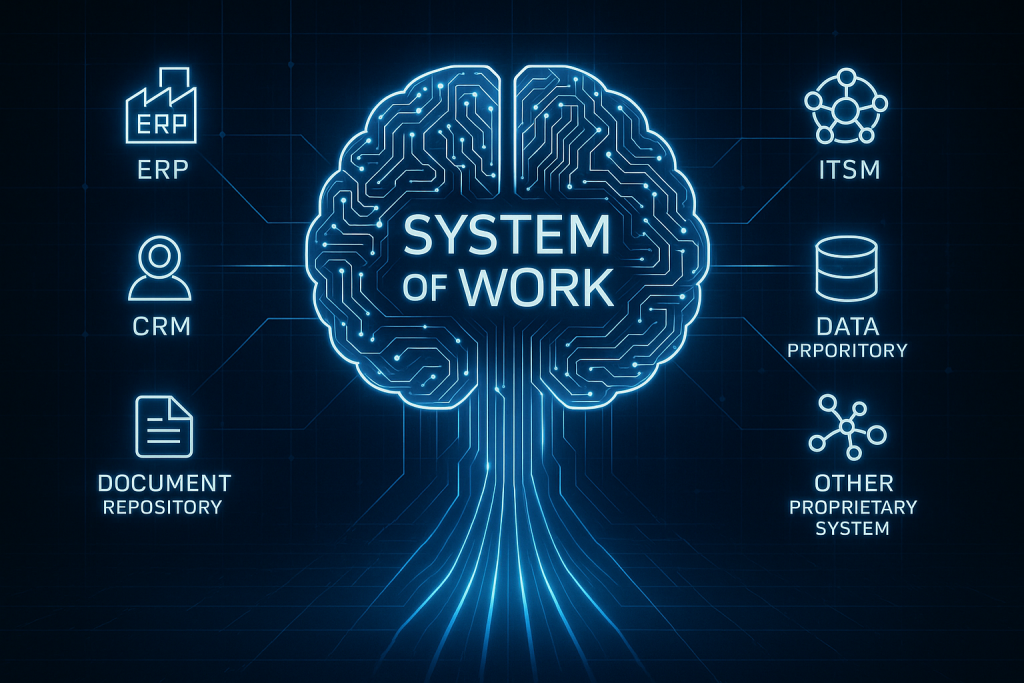
A System of Work, in contrast, is an ICT category designed to organise and structure knowledge around how work is actually done, not just what was recorded. These systems:
- Capture both explicit and tacit knowledge,
- Connect workflows, processes and decisions to real organisational context,
- Remove the need for integration through use of associative hyperlinking,
- Enable flexibility so value compounds over time without vendor lock-in.
Adopting a System of Work is not about implementing a single product. It is about confronting reality and embracing a new approach that empowers leadership with a clear articulation of the core function of their organisation. With a System of Work in place, leaders can make procurement and strategic decisions with confidence, anchored in a coherent understanding of how value is created. They are no longer forced to react to vendor incentives or legacy systems; they can proactively design for efficiency, innovation and growth.
ERP systems provide a cautionary tale here. Around 70% of ERP implementations fail to meet expectations (Gartner), often because they rigidly replicate broken processes instead of capturing the real work. Continuing to invest in ERP in the hope of “fixing it with the next module” only compounds sunk costs. In contrast, a System of Work, because it avoids hard-wired integrations (using associations instead), doesn’t trap organisations in the gravity well of a single vendor. Due to the plug-and-play nature of the associative linking used in a System of Work (instead of hard integration), tools and platforms can be swapped out with minimal pain. This is because the System of Work preserves the connective tissue: the context of how those tools are used and what knowledge flows through them.
Doing It Right the First Time
What does “doing it right” actually look like in practice? It means:
- Capturing tacit knowledge early. Structured interviews and process modelling helps to surface what employees know but may not have documented.
- Aligning investments with outcomes. Leaders must resist the sunk-cost fallacy of spending more on platforms that no longer serve.
- Structuring knowledge for AI-readiness. Rather than indiscriminately scraping unstructured data organisations link knowledge to workflows, processes and decision points.
Consider two organisations:
- Organisation A dumps decades of emails, SharePoint documents and PDFs into an AI platform. Staff spend as much time filtering noise as before and AI outputs are inconsistent and potentially unreliable
- Organisation B models workflows, links documents to real work steps and captures tacit insights. AI now serves as a personal intelligent assistant, providing timely, context-rich support. Over time, the system improves, reinforcing organisational memory and amplifying value.
The difference is clear: the hard yards upfront pay dividends over time. McKinsey research suggests that organisations with structured knowledge frameworks can see 20-25% productivity improvements, which in Australia’s case, translates to billions in saved time and more responsive services.
A National Imperative
Australia faces a transformational moment. Economic, demographic and technological changes are converging, with AI accelerating the pace of disruption. Alex Farquhar’s July 2025 National Press Club address emphasised that the workforce and institutions must adapt or risk being left behind. The future of work will require not just smarter tools, but smarter organisations. Organisations that prioritise their core business and only implement AI & automation to help facilitate it, will own the future. Their success will contrast harshly with others that remain distracted brainstorming AI use-cases, for its own sake.
By adopting Systems of Work as an ICT category across public and private sectors, Australia can:
- Preserve tacit knowledge and link it meaningfully to processes.
- Reduce reliance on rigid systems of record.
- Empower leadership to make strategic decisions grounded in a clear understanding of the organisation.
- Future-proof operations against vendor-driven lock-in and market disruption.
This isn’t just efficiency; it’s strategic sovereignty: ensuring Australia retains control over its knowledge assets and maximises the impact of emerging technologies.
Conclusion: Building an Enduring Advantage
Every shortcut taken today, whether scrappy AI ingestion, patching ERPs or ignoring tacit knowledge- becomes a sunk cost tomorrow. By contrast, investing in a System of Work compounds value: knowledge is captured, structured and linked to decision-making; enabling useful AI and empowering leaders through clarity and agency.
The choice is stark. Organisations can continue layering complexity on legacy systems or they can adopt a System of Work, reclaim control and prepare for the future of work with confidence. Leaders must show courage, recognise the sunk-cost-fallacies, and stand up to the multinationals by adopting innovative solutions and returning priorities to core-business. This courage is essential not just due to the benefits to specific organisations, but also because Australia’s success in the coming decade depends on those bold enough to do it right the first time.