
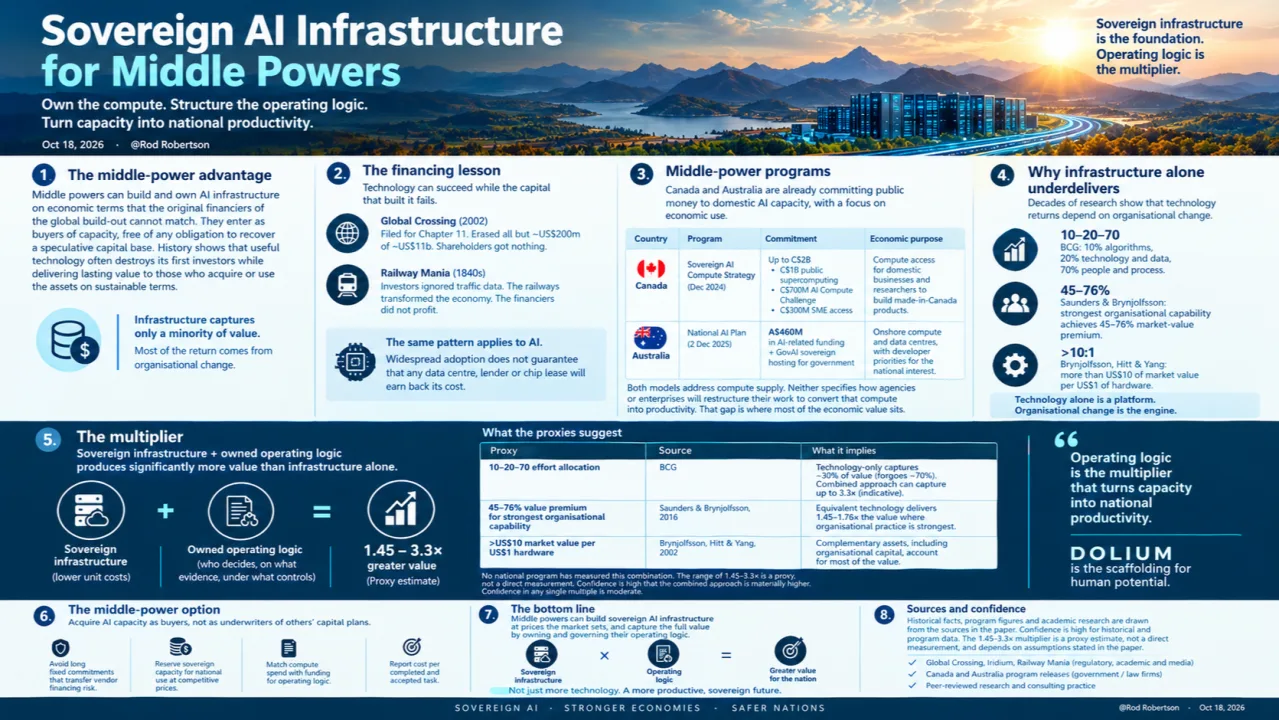
Combining Sovereign Infrastructure with Operating Logic
Summary
Middle powers can build and own AI infrastructure on economic terms that the original financiers of the global build-out cannot match. They can do so because they enter as buyers of capacity, free of any obligation to recover a speculative capital base. The history of network infrastructure shows that useful technology regularly destroys its first investors while delivering lasting value to whoever acquires or uses the assets on sustainable terms.
Infrastructure alone captures a minority of the available value. The evidence on general purpose technologies consistently places most of the return in organisational change: the redesign of processes, decision rights and accountability that the technology makes possible. A nation that owns its compute but leaves its operating logic fragmented will pay for capacity it cannot convert into productivity.
The paper's central claim is that sovereign infrastructure combined with an owned, structured operating logic produces savings significantly larger than either delivers on its own. On the best available proxies, the combined approach yields between 1.45 and 3.3 times the value of infrastructure alone. That figure is a proxy drawn from consulting practice and academic research. No national program has yet measured it directly, and the paper treats it accordingly.
The financing problem
A technology can succeed while the capital that built it fails. Global Crossing filed for Chapter 11 in January 2002 and its plan of reorganisation took effect on 9 December 2003 (SEC Form 10-K, 2004). The business buckled under heavy debt and a glut of capacity (Royal Gazette, via Reuters). It emerged having erased all but about US$200 million of roughly US$11 billion owed at filing (NBC News).
The fibre stayed in the ground and kept carrying traffic. The original shareholders received nothing under the plan (FINRA notice, December 2003). Demand for bandwidth and the solvency of the company that built it were separate questions with different answers.
Britain's 1840s Railway Mania follows the same pattern at national scale. Andrew Odlyzko describes it as by many measures the greatest technology mania in history and documents how investors ignored available traffic data showing that projected revenues could not be earned (Odlyzko, University of Minnesota). The railways transformed the British economy. The people who profited most were generally not the people who financed the lines (Mawer Investment Management).
The current AI build-out carries the same structural risk. Widespread adoption of AI does not guarantee that any particular data centre, lender or chip lease will earn back its cost at the prices competition permits.
Infrastructure outlives its financiers
The second owner of useful infrastructure often buys it on terms the first owner could never have achieved. Motorola's Iridium satellite network cost an estimated US$5 billion and its operator filed for bankruptcy protection in August 1999, less than a year after commercial service began (NYU Stern case note). A new owner acquired the network for US$25 million in 2000 (Smithsonian, Air & Space).
The successor recapitalised with roughly US$130 million, relaunched service in 2001 and sold the business for US$436 million in 2008 (Black Enterprise). The satellites were the same. The capital base they had to support was a fraction of the original.
This is the position middle powers occupy in the AI cycle. They are not obliged to recover the capital committed by the companies leading the global build-out. They can acquire compute, models and supporting services at prices set by competition and, if a correction comes, at prices set by distress. A government that builds or contracts sovereign capacity on those terms carries a capital base sized to its own economic use, and that is the source of its cost advantage.
The middle-power option
Middle powers are already committing public money to domestic AI capacity, and their programs are designed around economic use. Canada and Australia show two distinct models.
| Country | Program | Commitment | Economic purpose |
| Canada | Canadian Sovereign AI Compute Strategy, launched December 2024 | Up to C$2 billion: C$1 billion public supercomputing, C$700 million AI Compute Challenge for data centres, C$300 million SME compute access | Compute access for domestic businesses and researchers to build made-in-Canada products |
| Australia | National AI Plan, released 2 December 2025 | More than A$460 million in AI-related funding consolidated; GovAI sovereign hosting for government | Onshore compute and data centres, with expectations for developers released 23 March 2026 prioritising the national interest |
Canada funds capacity directly and subsidises access. Australia primarily sets conditions on private and hyperscale investment and reserves sovereign hosting for government workloads (Clifford Chance). ASPI has argued that investment conditions could include reserved compute capacity for Australian research, training and inference (ASPI Strategist).
Both models address the supply of compute. Neither, on the published material, specifies how government agencies or domestic enterprises will restructure their own work to convert that compute into productivity. That gap is where most of the economic value sits.
Why infrastructure alone underdelivers
Four decades of research on computing show that the return on technology depends on the organisational change made alongside it. Brynjolfsson, Rock and Syverson find that general purpose technologies such as AI require large complementary investments in new processes, business models and human capital, and that these are poorly measured in national accounts (American Economic Journal: Macroeconomics, 2021). Adjusting for the intangibles tied to hardware and software lifts measured US productivity 15.9 per cent above official figures by the end of 2017 (same source).
At the firm level, Brynjolfsson, Hitt and Yang found that one dollar of computer hardware was associated with more than ten dollars of market value, with the excess attributed largely to hidden organisational assets (Brookings Papers on Economic Activity, 2002). Saunders and Brynjolfsson replicated that finding and estimated a 45 to 76 per cent market-value premium for firms with the strongest organisational IT capabilities over those with the weakest (MIS Quarterly, 2016). Earlier work by Brynjolfsson and Hitt reported that firms can be worse off when they invest in computers without adopting new work systems (summary via AcaWiki).
Practice in AI deployment points the same way. Boston Consulting Group directs clients to place 10 per cent of AI effort on algorithms, 20 per cent on technology and data, and 70 per cent on people and processes (BCG).
Operating logic as the multiplier
On the balance of probabilities, sovereign infrastructure combined with an owned operating logic will save significantly more than infrastructure alone. The causal chain is direct. Cheaper sovereign compute lowers the unit cost of each AI task. Operating logic determines how many tasks are redesigned, how decisions are routed and recorded, and whether savings are captured in the budget or absorbed by unchanged process. Without that structure, lower unit costs mostly fund more activity of the same kind.
Operating logic here means the defined, governed and auditable description of how an organisation's work is performed: who decides, on what evidence, under what controls. When that logic resides within the enterprise, AI can be applied to it repeatedly across agencies without rebuilding it each time. When it is scattered across customised Systems of Record and fragile integrations, every AI deployment begins with expensive rediscovery.
No study has yet measured this combination at national scale, so the estimate rests on proxies.
| Proxy | Source | What it implies |
| 10-20-70 effort allocation | BCG | If value tracks effort, a technology-only program addresses 30 per cent of the value and forgoes 70 per cent, about 2.3 times what it captures |
| 45 to 76 per cent value premium for strongest organisational capability | Saunders and Brynjolfsson, 2016 | Equivalent technology delivers roughly 1.45 to 1.76 times the value where organisational practice is strongest |
| More than US$10 of market value per US$1 of hardware | Brynjolfsson, Hitt and Yang, 2002 | Complementary assets, including organisational capital, account for most of the value associated with computing investment |
The calculations are simple. Under the BCG proxy, 70 ÷ 30 = 2.33, so value forgone is 2.33 times value captured, and the combined approach captures up to 100 ÷ 30 = 3.3 times the technology-only result. Under the Saunders and Brynjolfsson proxy, the uplift is 1.45 to 1.76 times.
The conservative reading is that combining sovereign infrastructure with structured operating logic yields between 1.45 and 3.3 times the value of infrastructure alone. The lower bound comes from peer-reviewed market data. The upper bound depends on treating BCG's effort allocation as a value split, which BCG does not claim, and should be cited as indicative only. Confidence that the combined figure is materially higher is high. Confidence in any single multiple is moderate.
Recommendations
Middle-power governments should acquire AI capacity as buyers and avoid underwriting the capital plans of others. Contracts should reserve sovereign capacity for national use at prices that can be renegotiated as competition lowers costs. Long fixed commitments sized to a vendor's investment forecast transfer that vendor's financing risk to the taxpayer.
Every dollar committed to compute should be matched by funding for operating logic. Agencies receiving sovereign capacity should be required to define, govern and record how the relevant work is performed before AI is applied to it. That condition converts infrastructure spending into measurable savings and creates a reusable asset across government.
Operating logic should reside within the enterprise and remain portable across models, hosting providers and Systems of Record. Ownership of that logic preserves bargaining power when models and compute become interchangeable, and it prevents the next round of dependence from being built into customised platforms.
Programs should report cost per completed and accepted task. Compute capacity, licences consumed and pilots launched measure spending. Cost per accepted task measures whether the investment is repaying itself.
Sources and confidence
Historical facts on Global Crossing, Iridium and the Railway Mania are drawn from regulatory filings, academic work and contemporary reporting linked in the text, and are held with high confidence. Program figures for Canada and Australia come from government releases and law-firm briefings, also high confidence. The multiplier range in the operating-logic section is a proxy estimate built from peer-reviewed research and consulting practice. It has not been measured for any national program, and its upper bound depends on an assumption stated in that section.
- Global Crossing Form 10-K, fiscal 2004, SEC
- FINRA Uniform Practice Advisory 180-2003
- NBC News, Global Crossing settlement
- Odlyzko, Collective Hallucinations and Inefficient Markets
- Smithsonian, The Rise and Fall and Rise of Iridium
- NYU Stern, Iridium case note
- Black Enterprise, Syncom's New Frontier
- ISED Canada, Sovereign AI Compute Strategy
- Bird & Bird, Australia's National AI Plan
- Clifford Chance, National AI Plan key takeaways
- Brynjolfsson, Rock and Syverson, The Productivity J-Curve
- Brynjolfsson, Hitt and Yang, Intangible Assets
- Saunders and Brynjolfsson, Valuing IT-Related Intangible Assets
- BCG, AI at Scale