
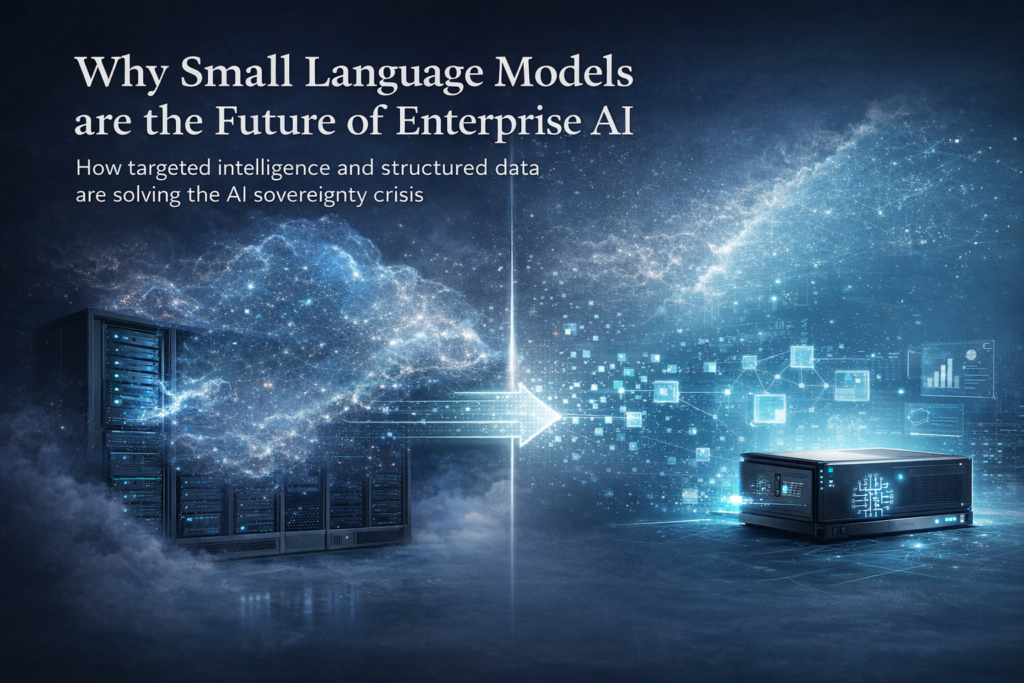
How targeted intelligence and structured data are solving the AI sovereignty crisis.
Imagine hiring a brilliant philosopher who has read every book in the world to manage your company’s payroll. They might possess boundless knowledge but they lack the specific, rule-bound focus required for the job. You do not need a polymath; you need an accountant.
This is the exact dilemma modern enterprises face with Artificial Intelligence. We have been trying to force massive, general-knowledge AI to execute highly specialised, secure workflows and it is proving to be an expensive mismatch.
Defining Language Models
Small Language Models (SLMs) prioritise specific relevance over sheer scale. While massive Large Language Models (LLMs) use hundreds of billions of parameters, an SLM typically uses a fraction of that compute power. Through a process called knowledge distillation, developers can compress the essential reasoning skills of a giant AI into a compact, highly focused framework.
This smaller footprint means they are incredibly fast and can run on standard enterprise computing hardware. However, to perform at its absolute best, an SLM cannot operate in a vacuum. It requires a structured operational environment. By clearly mapping how your organisational data connects, we reduce the AI’s workload and empower this smaller model to deliver expert-level results.
LLM vs. SLM: A Strategic Comparison
| Feature | Large Language Models (LLM) | Small Language Models (SLM) |
| Focus | General Knowledge | Domain Expertise |
| Deployment | Third-party Cloud | On-premise |
| Cost | High (Variable API Fees) | Low (Predictable Infrastructure) |
| Data Privacy | Public/Shared Risk | Absolute Sovereignty |
The Limits of the LLMs
In the high-stakes world of enterprise workflows, precision is non-negotiable: specifically in data extraction, regulatory compliance and task execution. While general-purpose LLM chatbots are impressive for brainstorming, they are often probabilistic engines that frequently hallucinate when tasked with parsing a complex legal contract or deciphering fragmented data schemas hidden within a legacy system.
Furthermore, for highly regulated industries, the “black box” nature of massive, centralised LLMs represents an unacceptable risk to digital sovereignty. Sending proprietary company data to third-party cloud APIs means relinquishing control over where that data lives, how it is secured and whether it might be ingested to train public models.
This is precisely where SLMs are carving out a vital niche. Unlike their general-purpose predecessors, SLMs are compact enough to run locally within your own perimeter, providing a true safe harbour for your data and a level of control that was previously impossible.
Moving to Modular Precision
The enterprise AI narrative is shifting from a focus on volume to a focus on value. Enterprises do not need an AI that knows everything; they need an AI that is an expert in their specific industry. This realisation is driving companies to target specific business problems with right-sized models that deliver higher accuracy, near-zero latency and strict domain expertise.
The financial argument is equally compelling. Running massive models in the cloud incurs significant, ongoing API costs. Because SLMs require less computational power, they can be deployed on existing infrastructure, shifting the AI budget to a more predictable, controlled model and avoiding the trap of runaway inference costs.
The System of Work
This transition to a cohesive modular AI’s ecosystem is only possible with an underlying Operations Ontology. This is the framework that structures chaotic business data into machine-readable context.
Without a structured environment, even the best model is limited by its lack of internal context. When paired with a robust ontology, an SLM becomes an expert system that understands the unique “dialect” of your business. This synergy between structure and intelligence is the architectural foundation of a new category of ICT platform: the System of Work.
DOLIUM: The Foundation of Intelligent Operations
Most companies sit on mountains of information trapped in ungoverned, disconnected legacy repositories. These digital filing cabinets are where data goes to be forgotten.
DOLIUM acts as a living data layer, creating a framework that has clear parameters to achieve your organisations objectives. When an SLM is introduced into the DOLIUM environment, it does not just read the data; it understands the context of the entire organisation. DOLIUM provides the secure, governed map of the data while the SLM provides the operationally relevant decision advantage.
Without the structure of DOLIUM, an AI is an isolated tool. With it, the AI becomes a native inhabitant of your business logic.
Crucially, this plug-and-play architecture reduces enterprise risk. By utilising DOLIUM, organisations can deploy a multitude of targeted SLMs to meet specific organisational entityneeds, while governing them centrally. As the AI landscape experiences major technological shifts, this modular agility means better, faster AI models can be swapped in without rebuilding the underlying data structure. The organisation owns the model, the infrastructure and the data.
A Resilient AI Future
The era of relying on massive, general-purpose AI is giving way to a more strategic, sovereign approach. Tying your enterprise to a single LLM creates a single point of failure.
The transition to a small AI strategy is a sophisticated evolution towards resilience. To begin this journey, Kitbag recommends identifying high-value tasks that require strict data sovereignty, mapping those tasks to a structured ontology in DOLIUM and deploying fine-tuned SLMs within that secure environment.
By prioritising the relationship between targeted models and structured data, DOLIUM helps you build a sustainable foundation where stagnant records are transformed into your sharpest competitive weapons.