
Today, the true bottleneck is semantic clarity: the extent to which an organisation’s knowledge, decision logic and processes are expressed in a machine‑readable form. Agentic AI, LLM‑driven decision support, RPA, autonomous workflows and orchestration layers are now capable of not only augmenting but performing work. Yet their effectiveness depends on a structured semantic backbone. Without it, automation remains too risky to confidently employ.
We are moving from a world where humans were planners and performers to one where the human plans are increasingly executed by machines. This is the macro shift reshaping organisational design.
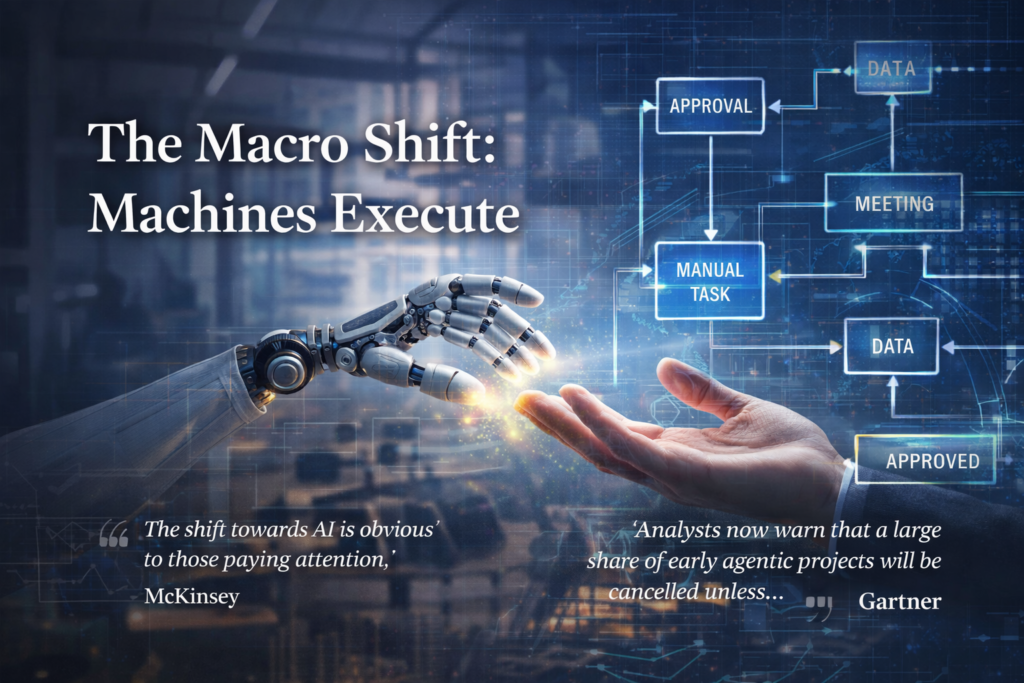
The Macro Shift: Machines Execute
The shift towards AI is obvious to those paying attention, yet the leap from experimentation to reliable, function-level deployment remains stubbornly difficult. Analysts now warn that a large share of early agentic projects will be cancelled unless business value, governance and controls are clarified. The reason for failure often is not the specific model, it’s the organisational environment the model must act within. Gartner
At the same time, decades of research show that many work activities are already technically automatable, underscoring that there is a clear limiting factor for scaling implementation and use of AI. If the tools are capable, why do so many initiatives stall? The answer lies in the organisation itself: scattered documents, tacit rules, inconsistent workflows and shadow governance create an environment where agents cannot reliably reason or coordinate. The next section maps those dysfunctions to the specific risks they create for automation. McKinsey
Current state: The Dysfunctions that Break Automation
Organisations commonly exhibit failure modes that directly impede automation:
- Tribal knowledge — essential decision logic lives in people’s heads, not in formal models.
- Shadow governance — informal, inconsistent practices circumvent formal policy.
- Platform-defined logic — vendor schemas harden into de facto policy, eroding sovereignty.
- Siloed documents across SharePoint, email, PDFs and spreadsheets — machines struggle to reason over scattered text.
- Fragile RPA — bots break when UI, process or context changes.
These are not marginal irritations. Knowledge workers routinely lose roughly 10 hours a week of time hunting for information, studies show. AI agents are unable to “figure out” an organisation from PDFs, SharePoint sprawl, tribal knowledge and inconsistent workflows. Even worse, LLMs acting without explicit task-level policy mapping must infer compliance; a structurally unsafe expectation for any autonomous system. They behave like human staff forced to interpret thousands of pages of rules without training or context. This context-gap is structural friction, a drag on scale and a hazard for agentic deployment. CFOtech Australia
Solving these dysfunctions requires more than just better governance checklists or another integration project. It requires a single, governed semantic model that both humans and machines can use: an operations ontology.
What is an Operations Ontology?
An operations ontology is a formal, machine-readable representation of an organisation’s core entities, relationships, rules, decision points and responsibilities. It is not merely documentation; it is the codified, governed logic that enables machines and people to share a single understanding of how work is meant to be done.
Practically, an operations ontology codifies:
- Concepts & entities (what is a “case”, “risk control”, “procurement action”, etc).
- Relationships & triggers (what conditions cause what actions).
- Decision points & inputs (what information is relevant to a decision and where it originates).
- Governance & ownership (who owns rules, how changes are versioned and approved).
Why it matters:
- Coordination: Humans and agents operate from the same logic.
- Consistency: Execution draws from a single source of truth.
- Governance: Every decision and exception is traceable.
- Resilience: Change in process doesn’t break automation.
- Sovereignty: Decision logic remains organisational IP – not vendor-embedded logic.
- Discovery: Automation and AI opportunities become visible, model-driven and prioritised.
An agent executing against an ontology doesn’t guess. It doesn’t infer. It doesn’t assume. It applies the precise policy relevant to the specific task it is performing. This is contextual compliance baked into execution, not bolted on afterwards.
Intelligence, Documentation and the Single Accessible Brain
Across history, societies have externalised intelligence in writing (laws, manuals, contracts, etc) to preserve knowledge and teach future actors. Digitisation of those same documents then improved discoverability. Operations ontologies are the next step and make institutional knowledge conversable for humans and actionable for machines. The argument for writing things down is the same argument for modelling: you externalise judgment, you make it portable and you make it testable. When models query a reliably governed ontology, they do not guess; they execute against codified organisational logic rather than probability. CSIRO and national AI roadmaps emphasise semantic and governance capability as foundational to trustworthy AI systems. CSIRO
Think of the organisation as a symphony:
- Operations ontology = the score (precise notation that represent the culmination of desired effects, detailing timing, interplay and intent).
- Orchestration layer = the conductor (the entity that interprets the score, using the formalised operations detail to coordinate tempo, entrances, dynamics).
- Agents (RPA / AI) = the musicians (each with their specific sheet of music that tells them exactly what to play, unified with others via the conductor)
- Organisation = the symphony (the emergent, coordinated performance).
Without the score, musicians improvise and risk discord. Without the conductor, agents work is isolated/siloed. Neither musician nor agent need to see the score/ontology they’re performing in its entirety but their conductor/orchestrator, does. In the era of agentic systems, the ontology is the score that prevents costly improvisation and enables reproducible performance.
The Unifying Rope: Modelling from Purpose Outward
To ensure a cohesive model that truly captures the organisation; operations ontologies should be modelled with a single organising centre: the Unifying Rope. Begin with the organisation’s fundamental purpose, the outcomes that define success and model outward.
The unifying rope anchors decision logic; but as you model processes that serve the core mission, you will also capture organisational differentiators. These are the tacit heuristics, policy nuances and institutional practices that make your operation unique.
This mission-first approach produces two benefits: it prevents horizontal, siloed modelling that creates conflicting semantics; and it turns previously tacit differentiators into codified institutional IP rather than undocumented, fragile practice. This mirrors best practice in Defence, national security and other high-assurance sectors where mission-centric design is non-negotiable.
System of Work: The Platform that Houses Ontologies
A System of Work is the operations environment where an ontology is created, governed, maintained and executed. It is an ICT category — not merely a governance abstraction — offering the tooling and control plane required for lifecycle management: collaborative modelling, traceable change, orchestration basis, change impact assessments, assurance, compliance and risk management. All these features exist natively.